How we picked
We started with every model a brand sells as a commuter or city bike, then ranked them on five things a commuter actually lives with: battery capacity in watt-hours, nominal motor power, the speed classes the bike supports, stated payload, and whether the brand states UL 2849 certification for the whole electrical system. Price per watt-hour was the tie-breaker. Commission played no part. Only two brands on this site pay us (Himiway and NIU), and the top pick is from a brand that doesn’t.
What matters most in a commuter e-bike
Certification first. You will charge a commuter indoors, often overnight. UL 2849 covers the e-bike’s whole electrical system (battery, charger, motor and controller working together), while UL 2271 covers the battery pack alone. Every model in our top five states UL 2849. New York City requires e-bikes sold or rented there to meet UL 2849, and more cities and landlords are following. See our UL 2849 safety guide.
Class flexibility. A Class 1 or 2 bike is limited to 20 mph with the motor. A Class 3 bike assists to 28 mph and is usually limited to pedal assist at that speed. Many commuter bikes can switch between classes, which is useful if your route mixes a protected bike path with a fast arterial road. Some paths and trails allow only Class 1 and 2. Our e-bike classes guide covers the details.
Battery size, honestly measured. Watt-hours is the real size of the tank. A 30-minute commute each way at moderate assist uses a fraction of a 600–700Wh battery, which means you can often charge every two or three days. Claimed ranges like “up to 80 miles” assume the lowest assist level, a light rider and flat ground. Our range guide shows how to estimate your own.
Weight and where the bike lives. If the bike goes up a flight of stairs or onto a train, every pound counts. The Aventon Soltera 2.5 is 46 lb; the Rad Power Bikes Radster Road is 74.5 lb. A removable battery helps, because you can charge it at your desk and lighten the bike for carrying.
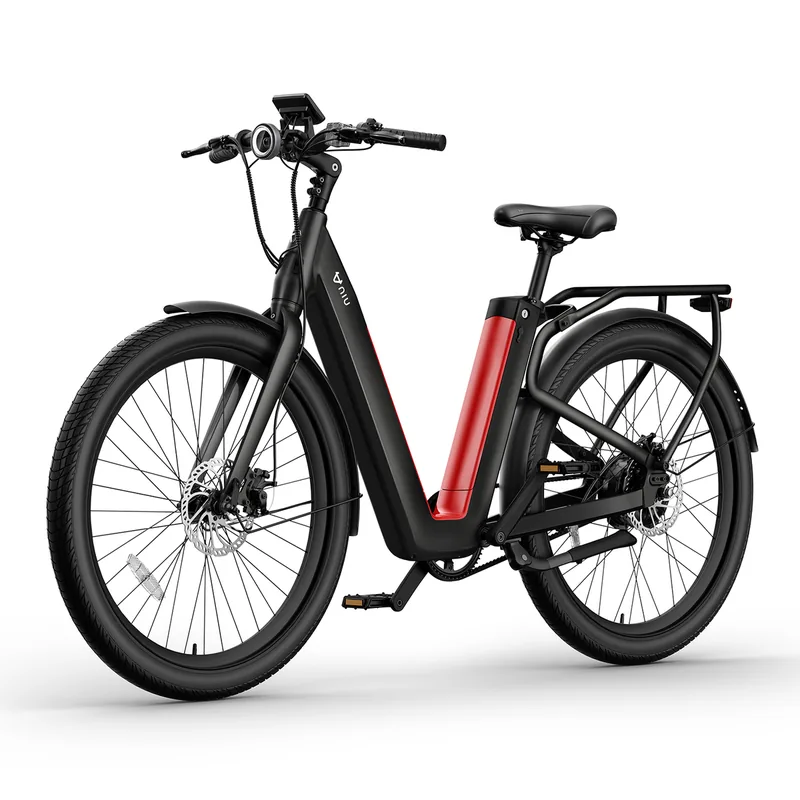
Payload. Payload is rider plus cargo. A 200 lb rider with a 25 lb pannier and a lock is already near 230 lb. The Velotric Discover 3 states 440 lb; the NIU BQi-C3 Pro states 287 lb. Leave headroom for hills.
Commuter accessories worth budgeting for
Most of these bikes include lights and fenders, but check the product page. Budget for a good lock (a U-lock plus a cable for the wheels at minimum), a rear rack if it isn’t included, panniers rather than a backpack for sweat-free arrivals, and a helmet. If you park outdoors, a seat cover and a habit of taking the battery inside will extend its life in cold or wet weather.
Safety notes
The U.S. Consumer Product Safety Commission issued warning 26-118 in November 2025 telling owners to stop using certain Rad Power Bikes batteries (RP-1304, RAD-S1304Y and HL-RP-S1304) sold with older models. Rad lists its newer Safe Shield batteries on the current models shown here, but if you buy a used Rad bike, check the battery model number. VIVI’s 2025 recall (CPSC 25-391) covered 36V batteries on bikes sold between December 2020 and November 2023. Both notices are linked on the affected model cards.
Frequently asked questions
What is the best e-bike for commuting?
On published specs, the Velotric Discover 3: 730Wh battery, Class 1, 2 or 3 switching, a 440 lb payload and UL 2849 & UL 2271, at $1,999 when we checked. If that’s over budget, the Lectric XPress2 offers a 672Wh battery and UL 2849 (bike), UL 2271 (battery) for $1,399.
How much range do I need for commuting?
Double your round trip, then add 30–50% for cold weather, hills and higher assist. A 10-mile each-way commute needs about 20 real miles a day, which most 600Wh-plus batteries cover comfortably at moderate assist, often for two or three days between charges.
Should a commuter e-bike be Class 2 or Class 3?
If your route uses fast roads, Class 3 (pedal assist to 28 mph) keeps you closer to traffic speed. If you ride mostly bike paths, Class 1 or 2 is often required there. Bikes that switch between classes, like the Velotric Discover 3 and Lectric XPress2, cover both.
Is it safe to charge an e-bike indoors?
Choose a bike certified to UL 2849, use only the original charger, charge on a hard surface away from exits, don’t charge a damaged or wet battery, and unplug when it’s full. Certification is the clearest signal a brand has tested the battery and charger together.
Related guides
How we work: every number on this page comes from the manufacturer’s official product page, checked Oct 15, 2026, and each model links to its source. Range and top speed are the brands’ own claims. We haven’t ridden or bench-tested these models, and prices change often, so check the current price on the brand’s site.